
The short answer
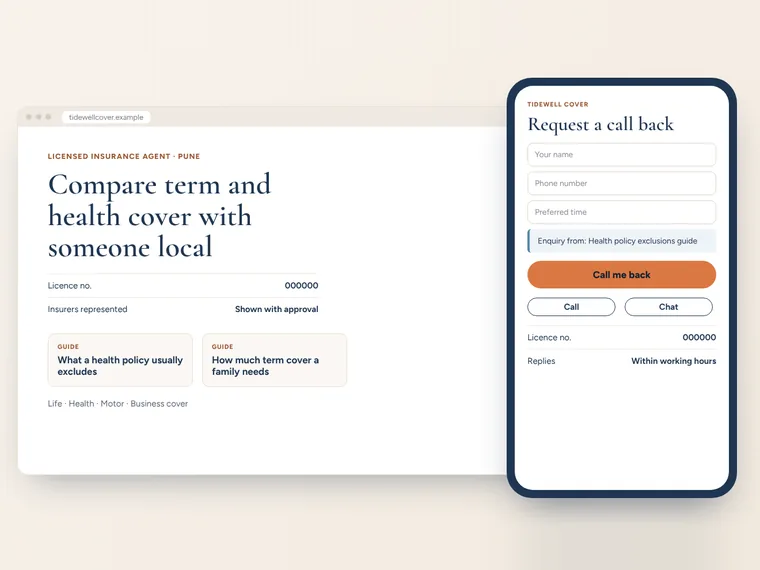
An agent's or broker's website should show who you are, your licence or registration, the companies or projects you represent where you are allowed to name them, what you help with and a quick way to ask a question. Follow your regulator's and principals' advertising rules, and make sure each enquiry reaches you while it is still warm.
Checklist
Does your agent website cover the essentials?
Twelve items, drawn from this article. Essential items are marked.
Tick what your website already has. Your answers stay on this page; nothing is sent or stored.
12 items, 8 of them essential. Tick the ones your website already has.
What should an agent's or broker's website include?
Start with the facts that let a stranger rely on you: your name, your licence or registration number exactly as issued, the area you cover and the kinds of clients you help. Put them where people expect to find them, in readable text.
Then say what you do, in plain words: compare term and health cover, help an investor start a systematic investment plan with the fund houses you distribute, find a home loan that suits a salary, or help a buyer shortlist flats in a registered project. Specific beats impressive.
Show the insurers, fund houses, lenders or developers you work with only where they allow it, because they usually control how their names and logos appear. Finish with a quick way to ask a question that works on a phone, and say when you reply.
What do regulators and principals allow you to show?
Agents and brokers answer to two sets of rules: their regulator's, and those of the companies they represent. This is where the main Indian rules stood on 14 October 2026; check the current text before you publish.
Insurance agents: the Insurance Regulatory and Development Authority of India (IRDAI) sets the rules. Its Protection of Policyholders' Interests, Operations and Allied Matters of Insurers Regulations 2024, in force from 1 April 2024, cover insurance advertisements. Advertisements issued by a distribution channel representing an insurer need the insurer's written approval before release, and must present products as the insurer's, not your own. Ask your insurer which pages of your site it treats as advertising.
Mutual fund distributors: guidance from the Association of Mutual Funds in India (AMFI) asks distributors to show the tagline 'AMFI-registered Mutual Fund Distributor' with their name, including on websites, and not to use names such as adviser, independent financial adviser (IFA) or wealth manager. AMFI's frequently asked questions also ask distributors to disclose their AMFI Registration Number (ARN), and not to show a fund house's name or logo without its prior written approval.
Property agents: under India's Real Estate (Regulation and Development) Act 2016 (RERA), an agent must register with the state authority before facilitating the sale or purchase of units in a registered project. State authorities add their own requirements; in Maharashtra, the Maharashtra Real Estate Regulatory Authority (MahaRERA) has issued orders on registration numbers and quick response (QR) codes in project advertising. Our guide for real estate agents covers listings in more detail.
Home loan agents: you usually act for one or more lenders, and your agreement with each lender sets out how you may use its name, logo and product details. Read it before the site is designed, not after.
In Australia, the Australian Securities and Investments Commission (ASIC) issued updated guidance on advertising financial products, financial advice and credit, Regulatory Guide 234, on 9 June 2026. Real estate agents are licensed by their state or territory. Check what your licence requires your advertising to show.
How do you earn trust before the first call?
Trust comes from facts a visitor can check, not from adjectives. Show your licence or registration details, use your own photograph and explain how you work: what the first conversation covers, what you need from the client and who they deal with afterwards.
Short guides to common questions earn trust quietly. A page on what a health policy usually excludes, or the documents a home loan application needs, brings people who are already thinking about the decision. Keep guides general, never promise returns or approvals, and remember that AMFI asks mutual fund distributors to take the fund house's prior approval before displaying or circulating write-ups that name its schemes.
Before: 'Best home loan agent in Thane. Approval guaranteed in every case.'
After: 'Home loan agent in Thane. I help salaried buyers compare loans from the lenders I work with and prepare their documents.'
Why: guaranteed approval and 'best' are claims nobody can check, and only the lender decides on a loan. The second version says who you are, who you help and what you do, which is all a visitor needs to decide whether to call.
How do you catch an enquiry while it is warm?
Make the first step small: a call-back request that asks for a name, a phone number, a preferred time and what the enquiry is about. Leave identity documents, income details and policy numbers for later, through a secure route.
Keep the context: when someone enquires from a listing or a guide, send the listing reference or page name with the request, so you call back knowing what they were reading.
Offer the channels people use: a call button and a click-to-chat link sit well beside the form on a phone. Say when you reply, and keep to it.
Own your leads: enquiries from your own site come to you, not to a portal that also shows other agents. Decide who receives them, test the route before launch and keep a record outside a single inbox.
Keep personal details out of web addresses and analytics, so nothing a visitor types is stored where it should not be.
Which website plan fits an agent or broker?
Brochure Website: fits an agent who mainly needs a credible profile and a call-back route. What it needs from you: accurate licence details and the approvals your principals require. What it cannot do: bring steady search traffic for many different questions.
Business + Blog Website: fits agents and distributors who want to publish guides to common questions and be found in local search. What it needs from you: time to review each guide, and your principals' approval wherever their products are named. What it cannot do: publish fund or product content without that approval.
Advanced Website: fits property agents with live listings, search and filters, or teams with several agents and enquiry routing. What it needs from you: someone who keeps listings current and removes sold or expired ones. What it cannot do: replace the registration details your state's rules require on each listing.
Honest exit: if all your work comes through referrals and your principals control every piece of advertising, a simple profile you can keep accurate may be all you need for now. Add-ons such as search engine optimisation (SEO), social media management, search and social ads, and logo and brand identity can follow; check with your principals before running ads that name their products.
What should you do next?
Write down your licence or registration numbers and the name you are registered under, exactly as issued.
Ask each insurer, fund house, lender or developer about its approval process for websites, and which names and logos you may use.
List the questions clients ask before they decide, and plan a page or guide for the most common ones.
Decide where enquiries go and who answers them, then test the route on a phone before launch.
Approve every line yourself, and review the site whenever your licence, principals or products change.
This article is general information about website design. It is not legal or professional advice. Rules change; check the primary sources and take qualified advice for your organisation. Information correct as at 14 October 2026.
FAQ
Can an insurance agent have their own website?
Yes, but content that promotes an insurer's products is likely to be treated as advertising, and IRDAI's 2024 regulations require the insurer's written approval before a distribution channel issues it. Speak to your insurer before launch and keep its approval on record.
Can I show the logos of the companies I work with?
Only with permission. AMFI asks distributors not to show a fund house's name or logo without its prior written approval, insurers approve advertisements that carry their products, and lenders and developers usually set the terms in your agreement with them.
Can a mutual fund distributor call themselves a financial adviser?
No, unless they are separately registered with the Securities and Exchange Board of India (SEBI) as an investment adviser. AMFI's guidance lists names such as adviser, IFA and wealth manager as not acceptable for distributors.
Do I need property listings on my website?
Only if you can keep them current. A few accurate listings with a clear status are better than a large catalogue of sold flats. If listings change often, plan for the Advanced Website and name one person to keep them up to date.
Sources and further reading
- IRDAI (Protection of Policyholders' Interests, Operations and Allied Matters of Insurers) Regulations 2024, Gazette of India, March 2024 (copy hosted by the Department of Financial Services)
- AMFI guidance on MFD nomenclature, Association of Mutual Funds in India, 2020
- FAQs on do's and don'ts for MFDs, Association of Mutual Funds in India, accessed 14 October 2026
- Real Estate (Regulation and Development) Act 2016, India Code
- Order on advertisements of registered projects (AdvOrder_126), MahaRERA, accessed 14 October 2026
- RG 234 Advertising financial products and services (including credit), ASIC, 9 June 2026