
The short answer
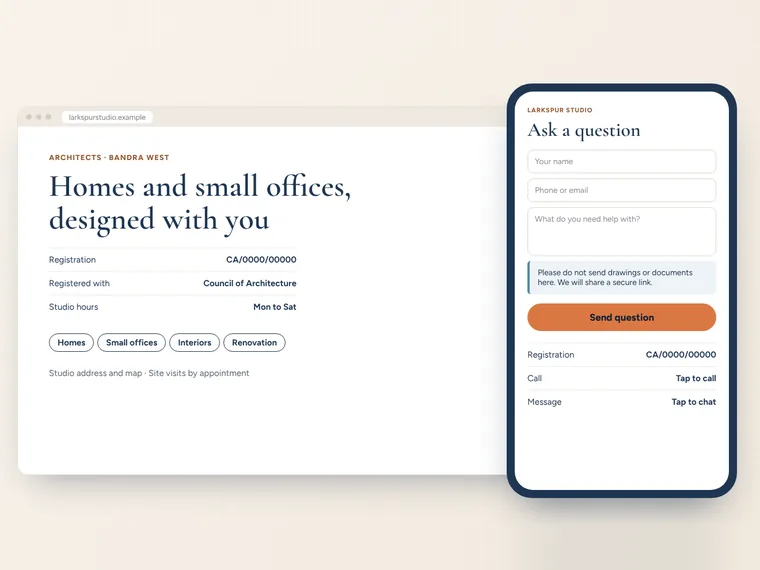
A licensed professional's website should show who you are, your registration with your professional body, the services you offer in plain language, where and when you work, and one clear way to ask a question. Keep every line factual, leave out testimonials, rankings and claims your rules restrict, and approve the final copy yourself.
Checklist
Does your practice website cover the essentials?
Twelve items, drawn from this article. Essential items are marked.
Tick what your website already has. Your answers stay on this page; nothing is sent or stored.
12 items, 9 of them essential. Tick the ones your website already has.
What should a licensed professional's website include?
Start with the facts a client checks before they call: who you are, whether you are registered, what you do and how to reach you. Use your name and qualifications exactly as your professional body records them, and show your registration details in readable text rather than inside an image.
Describe your areas of work in the words clients use. 'Help with a Goods and Services Tax (GST) notice' is clearer than 'indirect tax advisory', and a patient with knee pain will not search for a department name. Say who you usually help, such as individuals, small businesses or families, so the right people recognise themselves.
Then add where and when you work: the office or clinic address, a map, your hours and whether you meet clients online. Finish with one clear way to ask a question, and say what happens after someone sends it. Our guide for doctors covers clinic websites in more detail.
What do professional rules allow in India and Australia?
Each licensed profession has its own rules on publicity, and they differ more than most people expect. In India, the common thread is that a website may inform but must not solicit work. This is where the main bodies stood on 14 October 2026; check the current text before you publish.
Doctors in India: the National Medical Commission (NMC) issued its Guidelines on Ethical Advertising and Public Communication on 6 October 2026, in force immediately. They ask doctors to disclose their name, qualifications and registration number in online content. They prohibit patient testimonials used for promotion, promotional 'before and after' photographs, unverifiable claims such as 'best' or 'No.1' and fake or paid reviews. Factual information about the practice, including fees stated factually, is allowed.
Chartered accountants in India: the Institute of Chartered Accountants of India (ICAI) allows members and firms to have a website under its Website Guidelines. Its advisory of 14 October 2020 lists content to remove, including client names and logos, fees, labels such as 'Best Firm', awards and rankings, and testimonials that name clients.
Lawyers in India: Rule 36 of the Bar Council of India Rules 1975 says an advocate shall not solicit work or advertise, directly or indirectly. A website is limited to the particulars the Bar Council of India permits, so confirm its current position before you publish anything on the site. A lawyer's site stays strictly informational.
Architects in India: the Council of Architecture's Architects (Professional Conduct) Regulations 1989 say an architect shall not advertise their professional services. Exceptions added in 2003 allow an architect's name to appear in the classified columns of a professional directory or website. That is a listing exception, not a general licence, so ask the Council what a practice website may show before you add project galleries.
In Australia, registered health practitioners follow the advertising requirements of the Australian Health Practitioner Regulation Agency (Ahpra), which prohibit testimonials about clinical aspects of care. Other professions answer to their own state or national bodies, so check with yours.
What should you leave off the site?
Across these professions, the same items cause most problems: testimonials and star ratings used to promote you, words such as 'best', 'top' or 'No.1', client names and logos, awards and rankings, and results presented as proof. Leave them out unless your own rules clearly allow them.
Before: 'Mumbai's top architecture studio. Award-winning homes for discerning clients.'
After: 'Architects in Bandra West, designing homes and small offices. Registered with the Council of Architecture.'
Why: the first version advertises with claims nobody can check, which the Council of Architecture's regulations do not allow. The second states facts a client can verify and tells the right client that they have found the right practice, which is what the site is for.
Take care with images too. A stock photograph must never be presented as you or your team, and NMC's guidelines prohibit promotional campaigns generated by artificial intelligence (AI) for commercial interest, and require any permitted AI-generated content to say that it was made with AI.
Which features help clients without breaking the rules?
Service pages: one short page for each area of work, written around the client's question, helps people find you in search without any claim about results.
A short enquiry form: ask only for a name, contact details and a brief description. Say clearly that the form is not for confidential documents, and describe the reply route you actually follow.
A link to your secure portal: if you exchange documents with clients, link to the portal you already use rather than collecting files through a website form.
Articles that explain: short, general pieces on questions clients ask, written or approved by you, show how you think. Check your body's position on articles first and keep them free of claims about outcomes.
Call and chat buttons: on a phone, most people want to call or send a message. Make both easy to find and say when you usually reply.
Accessible pages: readable text, good contrast and forms that work with a keyboard help every visitor, including older clients and people using screen readers.
Which website plan fits a professional practice?
Brochure Website: fits a single practitioner with one or two services and one way to get in touch. What it needs from you: accurate registration details and a clear description of your work. What it cannot do: bring steady search traffic for many separate services.
Business + Blog Website: fits a practice with several services or partners, and someone willing to approve articles regularly. What it needs from you: a review of each article before it goes live. What it adds: pages and articles that answer clients' questions in search. What it cannot do: publish without your regular review.
Advanced Website: fits larger practices that need online appointment requests, several locations or a connection to an existing client system. What it needs from you: an owner for each integration and the information it handles. What it cannot do: make an integration acceptable on its own; your rules still apply to every page.
Honest exit: if most of your work comes through referrals and clients only need to confirm that you exist and how to reach you, a short Brochure Website kept accurate may be all you need for now. Add-ons such as logo and brand identity, search engine optimisation (SEO) and social media management can follow; use search or social ads only where your professional rules allow them.
What should you do next?
Collect your name, qualifications, registration details and practice address exactly as your professional body records them.
Read your body's current rules on publicity and websites, or ask your institute or council, before anyone writes copy.
List the questions clients ask most often before they hire you, and plan your service pages around them.
Decide who answers enquiries, through which route, and what a client should expect after sending one.
Approve every line yourself before launch, and review the site whenever your rules, services or locations change.
This article is general information about website design. It is not legal or professional advice. Rules change; check the primary sources and take qualified advice for your organisation. Information correct as at 14 October 2026.
FAQ
Can a lawyer in India have a website?
Yes, within limits. Rule 36 of the Bar Council of India Rules 1975 prohibits soliciting work or advertising, so a lawyer's website is limited to the factual particulars the Bar Council of India permits. Check its current position before you publish anything on the site.
Can I show client testimonials or reviews on my website?
For the professions covered here, generally no. NMC's 2026 guidelines prohibit patient testimonials used for promotion, ICAI's advisory lists testimonials that name clients among the content to remove, and Ahpra prohibits testimonials about clinical care in Australia. If your own rules are silent, leave them out until you have checked.
Can I show my fees on my website?
It depends on your profession. NMC's guidelines allow doctors to disclose charges that are factual, transparent and not misleading, while ICAI's advisory lists stating fees among the content to remove from chartered accountants' websites. Check your own body's position before publishing any fee.
Can I publish articles on my website?
Usually, if they are general, educational and approved by you. Keep them free of claims about results and of anything that reads as an invitation to hire you, and check your body's current position before the first one goes live.
Sources and further reading
- Guidelines on Ethical Advertising and Public Communication, National Medical Commission, 6 October 2026
- Advisory on compliance with the Website Guidelines, Institute of Chartered Accountants of India, 14 October 2020
- Bar Council of India Rules, Part VI (Rule 36), Bar Council of India, accessed 14 October 2026
- Architects (Professional Conduct) Regulations 1989, as amended in 2003, Council of Architecture
- Summary of the advertising requirements, Ahpra, reviewed 2 September 2025